In BX and OSE, there are no hard written rules for changing from one weapon to another. The closest thing we have to a source of truth is the notably messy Example of Combat on B26, which exemplifies more rulings than rules; the cleric “readies her mace and braces her shield” for a whole wasted round, while the Elf fires an arrow ahead of the group’s lost initiative and draws her sword without missing an attack.
I admit, this is wobbly proof that one can draw and sheathe without giving up an attack. If I’m adjudicating, I count the ten long seconds of a round, and it feels like gobs of time to sheathe or sling a weapon, pull another, and still make an attack. So that’s how I rule it. Yes, you can.
But say you disagree: Sheathing a sword and unhooking a Hammer should take a whole round, full stop.
Ok then. Let’s talk about holding things.
1. BX/OSE acknowledges that a character can attack while holding something in the other hand.
A PC can absolutely swing a sword while also holding a shield. Therefore, a PC can swing a sword while also holding a torch, a 10′ pole, a length of rope, a sandwich, really anything reasonable.
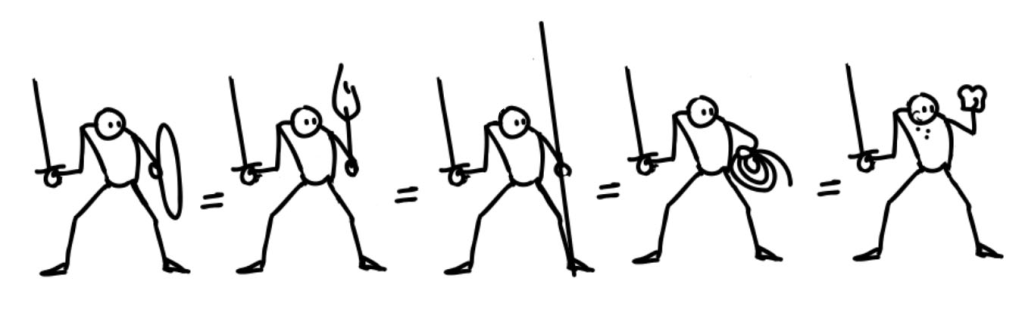
2. The other ‘something’ could also be a weapon.
There is no difference between holding torch vs a club, a pole vs a spear. None. As long as there’s no intent to dual-attack, it’s cargo.

3. BX/OSE does not acknowledge ‘handedness’
Simple rules. There are no righties or lefties. Combat is a complete abstraction of actions. So even if you imagine a ‘main’ hand and an ‘off’ hand, the game does not care. On this point, *I* would argue that as long as a PC is making one attack per round, it doesn’t matter which hand is doing the attacking, but if this doesn’t sit well with you, it still shouldn’t be hard to imagine switching a weapon from one hand to the other to attack in the course of 10 long seconds, because now, both weapons are already out and in hand.

4. The other hand could even be holding a 2H weapon
I buried the lead, but this is really what I’m driving at. If you can hold a shield, you can hold a sword. And if you can hold a second sword, it can be a 2H sword. And if you can hold a 2H weapon – just hold, not wield, mind you – then you can hold any 2H weapon, including things like bows.
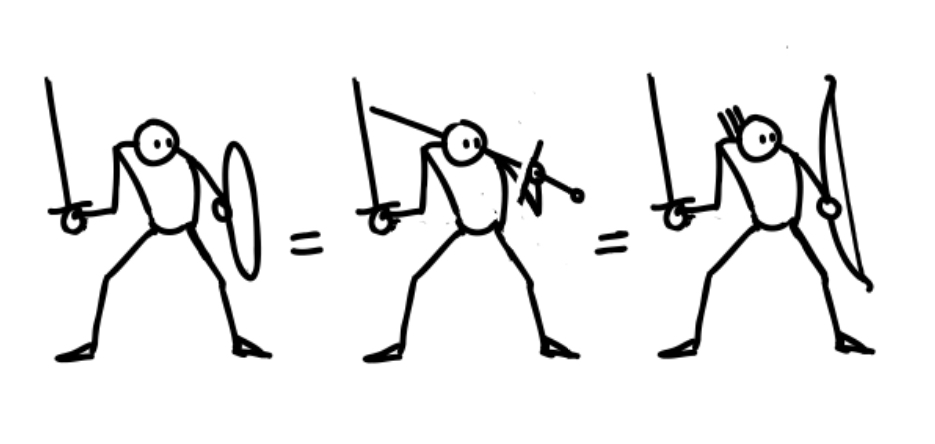
This opens a world of tactics, all by the book.
Mainly, it means you can very feasibly switch back and forth between slow weapons and non-slow weapons, from round to round. You’re not stuck acting last for all of combat, nor do you need to skip a round to swap arms. You can tactically choose when you really want to hold your action, and when you want to act on initiative (presumably, deciding before initiative is rolled, in fairness.)
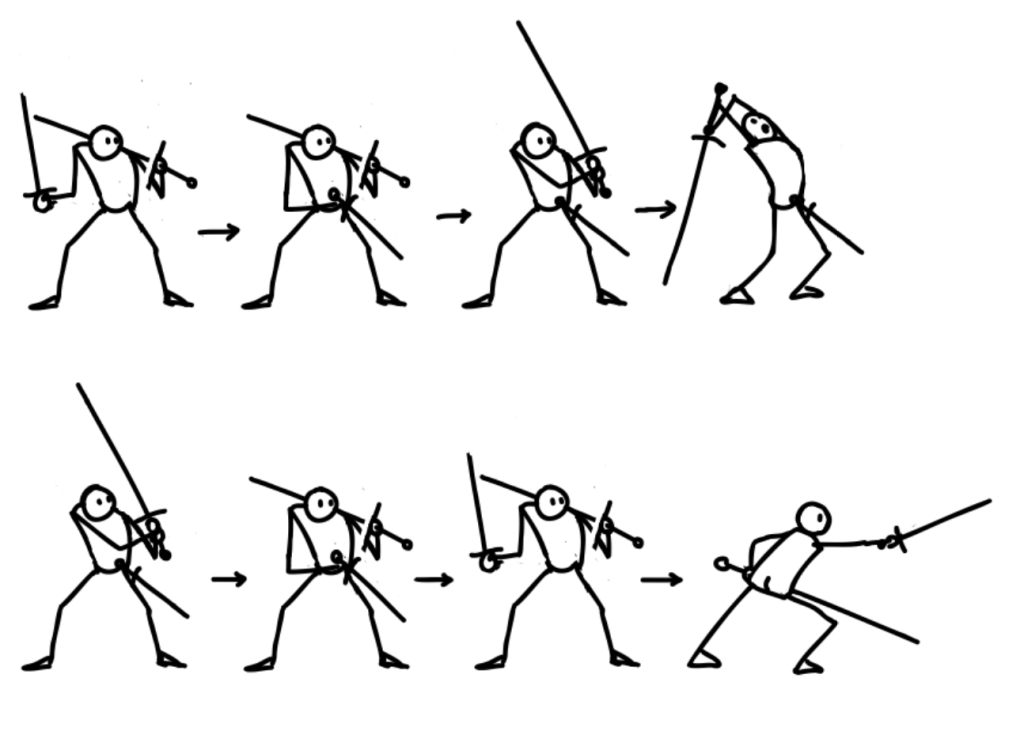
It means you can melee while holding a bow in the other hand without sacrificing a round to switch, even if the DM requires you to drop your melee weapon to nock an arrow.
It means you can fire at least one crossbow bolt, even if you have to drop your melee weapon to fire
It means you can switch to a ranged option weapon like a spear or dagger without skipping a round.
It means you can switch to a pole arm for range without losing a round, even if you have to drop your one-handed weapon.
It also makes d10 weapons *really* appealing for a backstabbing thief: They can’t use shields anyway so they’re not sacrificing protection, and their movement in leather (or unarmored) is broad enough to get them WAY out of danger after doing up to TWENTY SIX points of damage (d10+3 if they’re strong) and polishing off an already wounded opponent at +4 to hit.
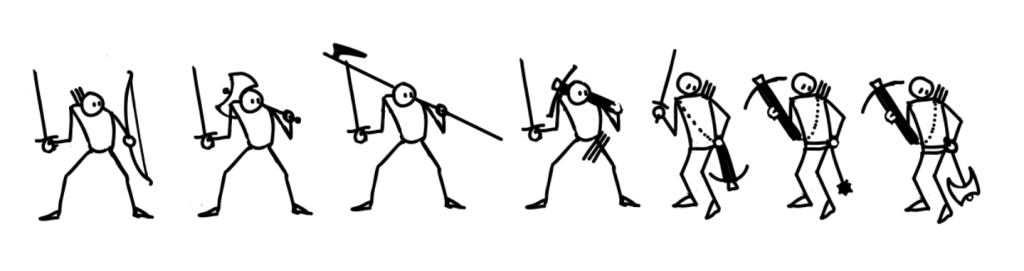
Now, like I said, this is all a LOT smoother if sheathing and unsheathing are permitted. Dropping a weapon on the floor is never ideal, but if your table is really committed to sheathing occupying a full round, then holding a second weapon at least gets you out of being skipped for doing something mundane.
As always, food for thought at your table. I justify my assertions here from the text and from what I believe are very short, axiomatic deductions, but your table is yours, always.
F#

 "You see this."
Leave a comment