Not. One. Edition. Prescribes. An. Order.
This is not an opinion. This is not an interpretation. No order prescription appears in the ink of Holmes, BX, BECMI, or the 1991 or 1994 Basic Box instructions, or Old School Essentials (citations below). The closest you get is Method III in AD&D, which is one of several suggested methods — it’s not 3d6, and it’s not even the first method.
For what it’s worth, I understand and respect the commitment of those who espouse that the dice should entirely decide the PC’s nature, and that this is only accomplished when the player can not ascribe high and low rolls to abilities that influence the PC’s survivability or specialty.
I get it. I do.
But there’s a difference between saying “I prefer it that way,” and claiming that the rules dictate an order. They do not. So what’s the source of confusion?
Original D&D, Men & Magic 1974, p.10
An ambiguous bit of language in the game’s origin convinced everyone that there was one rigid procedure for rolling up a character. Here’s the ambiguous text:
“Prior to the character selection by players it is necessary for the referee to roll three six-sided dice in order to rate each as to various abilities and thus aid them in selecting a role.“
The mistake is in reading, “roll three six-sided dice in order to rate”
The provably correct way to read this is, “roll three six-sided dice in order to rate“
In order to rate each one. As a means of rating. A method of determination.
But how can one prove this is the correct way to read this sentence?
Because there is no order! It’s not even a list! It’s barely even sorted into columns or rows! It looks like this!
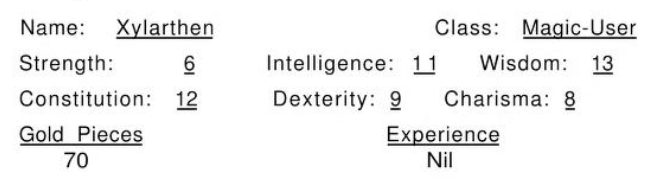
Is the right order…
Down the three wonky columns? S-C-I-D-W-C?
Across the wonky rows? S-I-W-C-D-C?
Are either of these the sworn “order” of S-I-W-D-C-Ch?
No! And it doesn’t matter anyway, because the instructions never say to roll them in any sequential order in the first place! Sure, the paragraph above it spells out the categories, but that’s it. Nowhere does it say “starting with Strength…” or anything even close.
Let’s look at context from the rest of the game’s language:
1. There are 16 other appearances of the phrase “in order to” in Men and Magic. They are all very clearly intended to be read, “as a means”, in context.
2. There are 18 more instances in the Greyhawk Supplement. 17 of them are read “as a means”, and one of which means “appropriate” (congratulations are ‘in order’).
“In order to” means “as a method of”, every time.
What do the Basic editions actually say?
Let’s look at the language in each basic edition from 1976 to 1994. What do the words on the page actually read?
Holmes 1976 p.5
“Each player starts a character by rolling three 6-sided dice for each characteristic.“
The roll order is not specified. You can roll 6 scores without assigning any of them and you will have rolled three 6-sided dice for each characteristic, to the letter.
BX 1981 p.B5
“Roll 3d6 (for a result of 3-18) for each ability and put the result in pencil next to the name of the ability.”
The roll order is absolutely not specified. But this is spiritually as close as it gets. Tom Moldvay uses a definite article: the ability. So while you could absolutely start with Wisdom and end with Dexterity, we might be able to infer a declaration of intent is expected: “I am rolling for my Wisdom ability, and I will put the result next to the name of the ability.”
That said, if my wife tells me to, “cut a slice of cake for each guest and put the slice next to the name on the place card,” that doesn’t mean I’m going to call out a person’s name in some bonding ritual before cutting each slice, that would be pretty unhinged. It just means I’ll cut a slice per person, and then hand them out based on who wants a larger or smaller slice. Just like ability scores.
BECMI 1983 basic player guide p.48
“[…] you will roll dice to find each Score. This is done by rolling the six-sided die three times, and adding the results. Or, if you have other six-sided die, roll 3 dice together. […] Write the scores down as you roll them, next to the names of the Abilities.
The roll order is not specified. (Also, weird syntax, Frank. Find a score? Have other die? You mean dice?).
Dungeons & Dragons Game 1991 p4
The Classic Dungeons & Dragons Game 1994
Both editions use the same language:
“Ability scores are determined by rolling 3d6 so they range from 3 to 18.”
The roll order is not specified.
Later, the checklist reads:
“Roll abilities (Strength, Intelligence, Wisdom, Dexerity, Constitution and Charisma)”
But, this is just a checklist, a reminder to make sure you have already rolled all of the ability scores.
OSE 2018 (advanced tome p16 Classic tome p.14)
Roll 3d6 for each of your character’s ability scores: Strength, Intelligence, Wisdom, Dexterity, Constitution, and Charisma.
The roll order is not specified. This is just a list of the abilities.
Wrap it up
I understand the commitment to allowing the dice to purely determine the abilities of the character. It’s painfully ironic that the same people who commit to this are often the same people who disparage 5E players for “roll playing, not role playing” precisely for allowing the dice to purely determine the abilities of the character! It’s also ironic that these same folks are quick to encourage their players to persist with a ‘hopeless’ character because “low ability scores don’t really matter!” and yet good scores matter so much that it’s against their table rules to assign high rolls at will.
Weird, huh?
Posts like this take fire because they challenge long-held beliefs. In some ways it’s almost like challenging a person’s religion; they can’t put their finger on a fact that says so, but they feeeeel like 3d6 in order is the almighty’s righteous intent, and they’ll go to the mattresses defending it.
As always, play the game as you will. But do consider the fact that “roll 3d6 in SIWDCcH order” is a culture, not a rule.



 "You see this."
Leave a comment