There are so many misconceptions regarding Running in BX and OSE that it’s difficult to determine where to begin explaining a correct RAW understanding. These are my TL;DR conclusions after a recent deep dive where I flip-flopped half a dozen times:
1. On B24, Encounter movement is clearly defined. Running is defined next, followed by Evasion, and then Pursuit. If you would argue that Running is an extension of Encounter movement, just stop here. You’re done, you’re wrong, it’s a bad faith argument that tortures the language. Running is defined prior to Evasion and Pursuit because it’s a building block to understanding Pursuit. This is how legal and rule documents are structured.
2. I think Gavin made the right call in OSE: BX pretty clearly tells us that Evasion and Pursuit are intended to get the party out of an encounter before the fighting starts. It’s not the only call that could be made, but it’s the most apparent one that can be supported directly from the BX text without stretching the language.
3. Encounter movement rates apply while you are participating in the encounter, and that includes combat. (Though you could make a case for fleeing from the encounter mid-combat.) So no, individual combatants can not run within combat. Running ends and exists the encounter.
Here’s the support for each, stipulating that the PCs are the fleeing side, and the monsters are aggressive for the sake of linguistic clarity.
1. How to write instructions
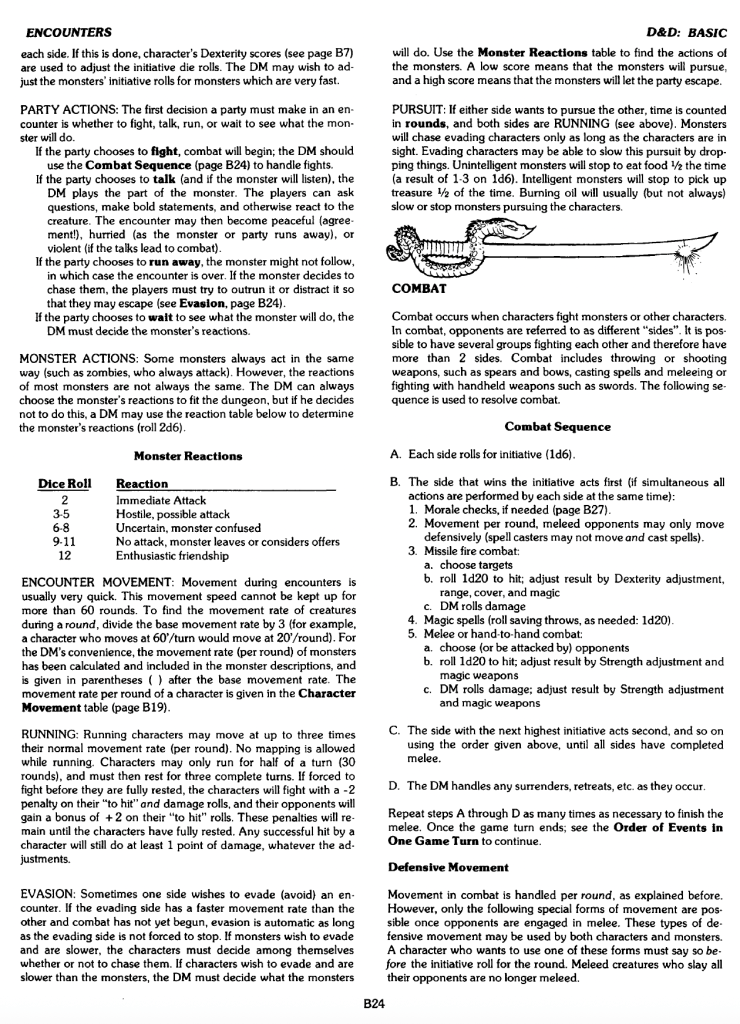
This is page B24.
“ENCOUNTER MOVEMENT” defines the rates of movement during an Encounter. You can not move faster than your encounter rate during an encounter. This really should be self-evident.
“RUNNING” defines running and the associated penalties. You need to know what Running is to understand Evasion and Pursuit which follow.
“EVASION” defines the conditions of automatic evasion and what conditions precipitate Pursuit.
“PURSUIT” is defined as running, and covers which conditions end Pursuit for better or worse.
This is all I have to say about arguments that defy basic literacy. Not in my house.
1. BX vs OSE
Here’s what OSE says about Evasion:
“If one side wishes to avoid an encounter, it may attempt to flee. This is called evasion and is only possible before combat has begun.”
Here is the original wording on B24, piece by piece:
“Sometimes one side wishes to evade (avoid) an encounter.”
This is the first clue. It clearly says avoid an encounter. The whole encounter. Even before it becomes combat, the party says “We run away.”
If the evading side has a faster movement rate than the other and combat has not yet begun, evasion is automatic as long as the evading side is not forced to stop.“
Some encounters start with a surprise attack, so this provision clarifies that even if your side is faster, you can’t avoid an encounter if it’s already underway as combat.
“If characters wish to evade and are slower than the monsters, the DM must decide what the monsters will do. Use the Monster Reactions table to find the actions of the monsters.
So this is another big clue. The DM doesn’t even know whether the monsters are friendly or aggressive yet. Evasion is being decided before the reaction roll. So we’re at step 5 of the Turn sequence on B23: Rolling encounter initiative. The DM has just rolled type, number, distance, and surprise, and it’s time to decide whether to stay (hide, parley, fight) or to run away.
“A low score means that the monsters will pursue, and a high score means that the monsters will let the party escape.“
If the monsters are not aggressive, whether the party is faster or slower, evasion is automatic. No reason to pursue.
If the monsters are aggressive (5 to 2) and the party is faster, evasion is automatic.
If the monsters are aggressive (5 to 2) and the party is slower, evasion is not automatic, the monsters pursue.
Remember, even on a 2, the monsters don’t get to attack instantly… combat has not begun. It says so right here:
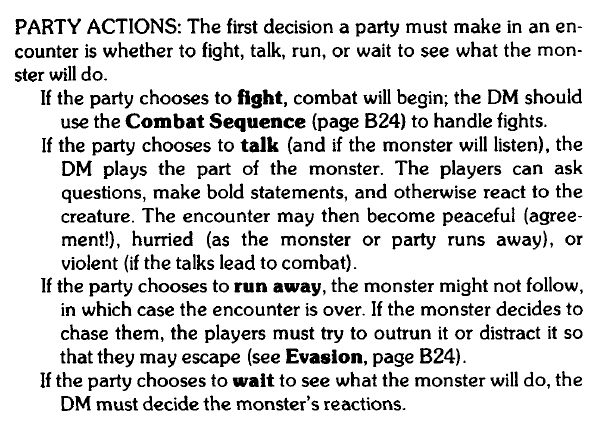
You still have to make declarations and roll combat initiative before combat starts. Right now, the Encounter initiative is the part where the sides telegraphs what’s going to happen next.
PS. If you need more proof than that, consider the fact that most of the running definition describes penalties for an entire party that’s been running for a full 30 rounds. There is nothing in that definition that even hints that this is an action intended to be undertaken by a single individual, much less during combat.
3. Encounter rates govern encounters!
I’ve encountered the same strange argument from at least 3 different people while discussing running, and it all stems from dropping the context of combat from this retreat description on B25:

The argument is that running at 3x fits the bill for “Any movement at more than 1/2”.
This is a bit like having a paralyzed character while pointing to the combat sequence on B24, saying “I should be able to move and attack, it says so right here.”
Yeah, if you weren’t paralyzed, sure. But you are, so the context matters.
Similarly, the context here is that you’re engaged in melee in the middle of combat in the middle of an encounter. So whatever you do, you’re limited to Encounter movement rates until the Encounter ends. CAN you run at 3x? Absolutely. If you weren’t in an encounter. But you are.
4. Leeway
First of all, I’ve played at tables that allowed running in combat. You give up your action to move 3x. Nothing bad happens, it does not break the game. It’s a fine house rule.
Secondly, we’ve established that the decision to Evade is intended to be made in that momentary space before the Encounter begins. The PCs are staring down the monsters. The Monsters are staring down the PCs. The monsters are aggressive. The party has their weapons out.
What else does that sound like?
Does it sound exactly like the space between ranged combat rounds where no one is meleed? Because it should.
The fact is, the difference is meta and semantic. So you could easily rule that as long as no one is in melee, a side could choose to evade, ending the encounter and the governance of encounter movement rates, and start running as the encounter becomes Pursuit.
And if you’re using individual initiative where each individual constitutes a side, then as long as that individual (and the DM!) are comfortable with splitting the party, then a single PC could decide to exit the encounter to evade.
Of course, that gets a little messy (as usual when we start breaking BX rules apart).
1. A PC fleeing would technically commit at least one monster to pursuit, else it would be an automatic evasion. If there’s only one big monster fighting the party, well, the DM either has to break that rule or explain why the BBEG took off after Bobo Furtoe just because he ran. (Maybe its vision is movement based, like a T-Rex, I dunno.)
2. You’d have to start thinking about how far the PC would have to run to be “out” of the encounter. If encounter distance rolls start with 2d6x10, then you could still be in an encounter at 120′, so you might rule that the PC needs to run over 120… which could take that PC multiple rounds if their running speed is 60′ or 90′. And then you have to figure out how to bring them back in, should they decide to return (do they get a surprise roll?)
Anyway, you get the idea. Evasion is meant to be a full party tactic that occurs before combat begins, so if you bend those rules, other rules start to break in unexpected ways, as usual.
 "You see this."
Leave a comment