This is a short rant.
Around when I first posted “Just hold it” I also created this doodle to explain a superior approach to using slow, d10, 2H weapons:
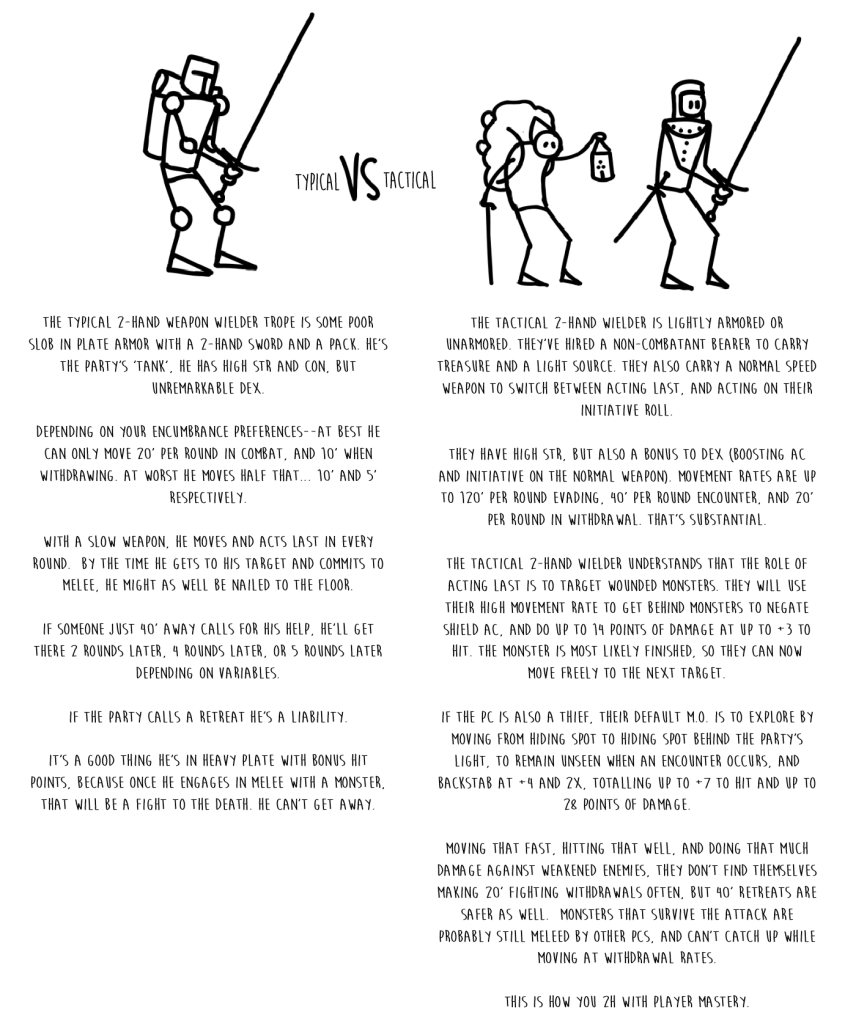
In brief, it explains that the slow, heavy 2H tank trope is a mistake. The wielder is better off unarmored, frankly. While the former is effectively nailed to the floor in melee, the latter can zip around—even while acting last—to target weakened monsters who are already pinned in melee by other PCs, and perform back-to-back coup de grace… especially if that two-hander is a backstabbing thief.
Between the “hold it” article and this ^ piece, I drew some criticism. One person called it “meta gaming” another called it “min maxing”, and an audience of readers agreed by like or upvote.
The thing is, that’s what player mastery looks like, and that’s the OSR paradigm.
Player mastery is knowing the game
You know the dungeon world better than your level 1 PC. And you can role play your PC’s naiveté as much as you want the first time they encounter an old trope, but if you’re not applying the experience that YOU gained as a player for the last 30 years at the table to make sure your PC survives, you’re arguably playing poorly.
OSR PCs don’t enjoy character mastery. They don’t get background, insight, or perception checks to understand their world. You’re on your own as an OSR player. It’s your wits and experience vs the dungeon, and your PC is just the empty vessel into which you pour that understanding. Your early PCs had short careers. Your recent PCs have longer shelf-lives. That’s your mastery.
So if you’ve learned (the hard way) that piloting a plated fighter through combat with a slow 2H sword f*cking sucks when you’re trying to save your companions or run away, you have every right to apply that knowledge. That’s your mastery.
It’s the way you’re intended to play the game. You learn from your mistakes and calculate risks.
The campaign depends on it. The whole OSR depends on it.
 "You see this."
Leave a comment