I suspect a lot of GMs make Raise Dead a lot less accessible than the game’s authors intended it to be. Here’s why.
TL;DR
- The base town should be 1 day from the dungeon (X54), that journey should be safe from level 1 to 3 (X19), and the town should include a Cleric who can cast Raise Dead (X54). That’s a 7th level minimum (9th level is arguably more likely if they oversee their own temple).
- 1 day is exactly how much time a 7th level Cleric has to raise a dead body, assuming axiomatically that the spell works same-day at 7th level when received.
- There is no permanent penalty for raising or being raised. (X14)
- Cost is not defined, this is purely up to the referee. (X19)
- There are zero restrictions regarding body condition. (X14) (Except perhaps the 6-turns-until-digested rule.)
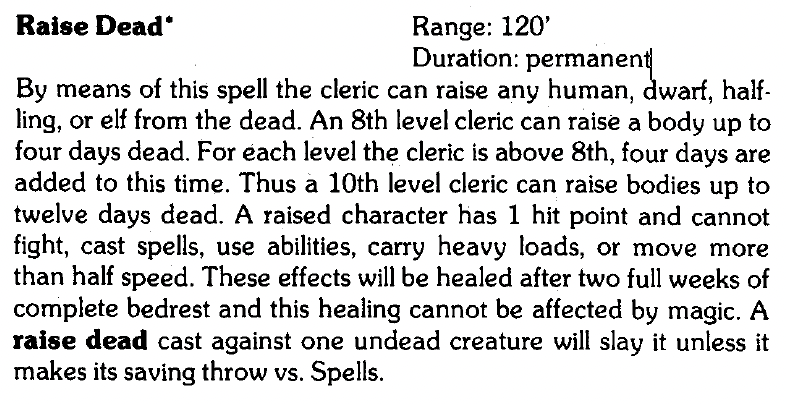
Raise Dead, X14:
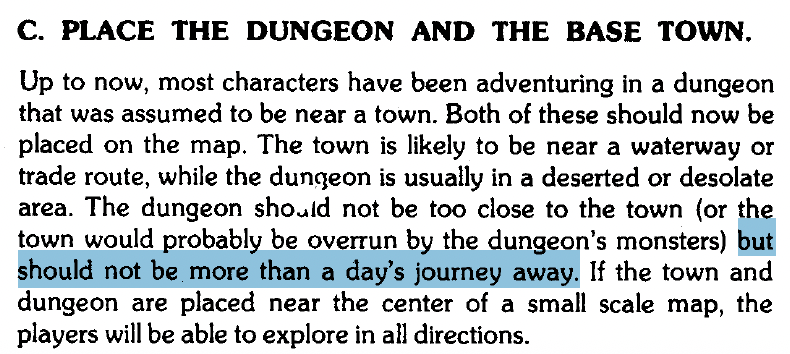
How far the base town should be from the dungeon, X54:
Low-level travel to the dungeon should be safe, X19:

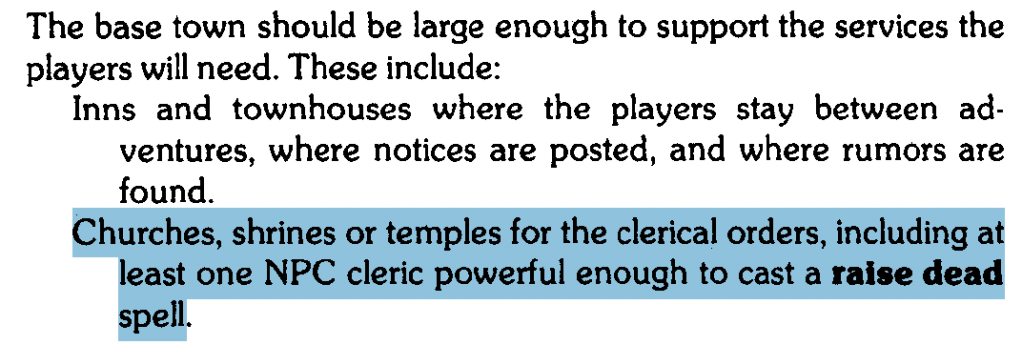
Base towns should have a Cleric who can Raise Dead, X54:
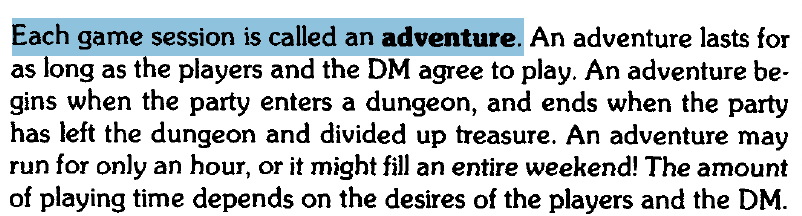
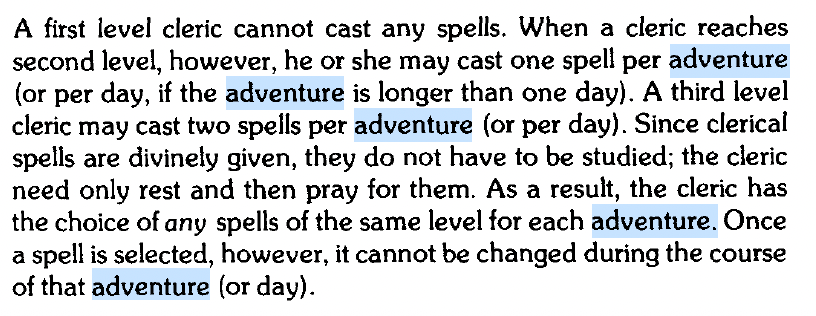
Adventures are expected to be hours-long (a session), rarely more than one day; the term is generally interchangeable with “day”. PCs are expected to end the adventure and return to town daily, thus it should be possible, B3, B15, B19:

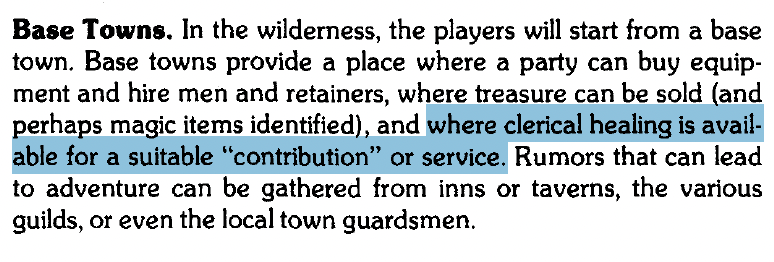
Clerical service fees are undefined as “suitable”, X19:
Raise Dead at 7th Level
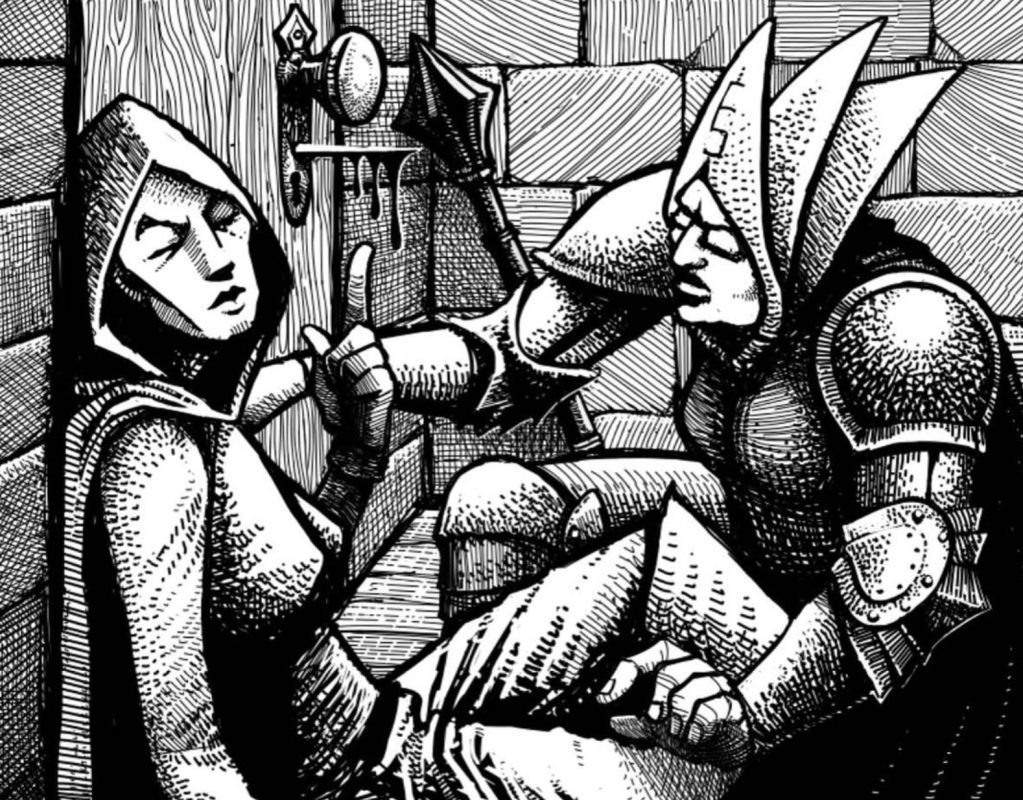
Feasibly, every Temple in the D&D universe should contain one person capable of casting a 5th level spell. The game tells us that at 9th level a Cleric may establish a stronghold, so it stands to reason that if a temple exists in the world, there may well be a 9th level Patriarch responsible for it, or at least that a 7th level Cleric has been assigned to it.
If we align 14 Clerical levels with a clergy structure like the Catholic church, a 7th level Cleric (Bishop) is actually the equivalent of a Pastor: The guy in charge of the local Parish. So even if the 9th level Cleric is out, it’s feasible you should find a 7th level Cleric running the place. Anyone lower than that isn’t considered mature enough to oversee operations, if you check the definitions for Elders, Vicars and Curates.
So as long as the referee put a temple in the town, there should be someone in it able to cast a 5th level spell.
Penalties: zero
RAW, there is no permanent constitution loss, no roll to succeed, no saving throw, no XP loss, no limit. 2 weeks of in-universe rest, and your PC is back on their feet. The caster suffers no period of exhaustion either; it is cast as easily as Bless or Light.
So if the referee is attaching penalties, that’s a personal choice.
Time
You have at least 1 day to get the body to the Cleric. The RAW is admittedly less than explicit; it tells us 4 days per level over 7th, with an example of 12 days for a 10th level Cleric, which means 8:9th and 4:8th, which leaves at least “the rest of day 0” for the 7th level Cleric.
But here’s the beauty of the design: the game stipulates that an adventure is a single day of dungeoneering. In other words, the characters are expected to leave the dungeon and go back to town every single day anyway to divide treasure and tally XP.
So unless your GM deliberately has the party adventuring more than at least 12 miles from town (60/5, at slow encumbrance) to prevent you from returning, in time, this should be doable.
Safety
The game explicitly states that low level travel to and from the dungeon should be safe and without danger.
Cost
The RAW doesn’t describe any price or exchange of service for the spell. So any notions of prohibitively expensive Raise Dead castings or questing for for the favor of the spell is 100% GM fiat. It doesn’t have to be prohibitive.
Condition
Check the spell description again. There’s not a RAW word in there about the condition of the body.
RAW, one could argue that a body could be a pile of ashes scooped into a pouch, a bucket of goo extracted from a gelatinous cube, or a chewed up corpse. So if your referee says “too far gone”, that too is personal choice.
SYNOPSIS
If you’re going to play RAW so that death occurs at 0hp, take a moment to reflect on how the rest of the game’s architecture was designed to forgive that brutality. The Basic and Expert game was intended to be joyful, not punishing. And part of that joy was doing a swan dive into a spiked pit, getting dragged to a temple at the end of the day, and rejoining the party after a 2-week rest.
You weren’t meant to tear your character sheet in half as soon as the PC keeled over. The game’s rules are brutal in the short term with dozens of ways to die instantly; but it’s gentle in the long term. The expectation is that the party will experience many deaths over many daily adventures.
So if your referee has designed the world surrounding your PCs in hardcore mode—no town within miles, no temple or 7th level caster available, extortionate prices, conditional castings, or penalized success—that’s a lethal ref, not a lethal edition.
As always, food for thought. Your table is yours without judgement. Thanks for taking the time to think this over.
Regards,
Frankie


Leave a Reply