Consider this: Encounter initiative rolls

Throwing this here for the sake of posterity:

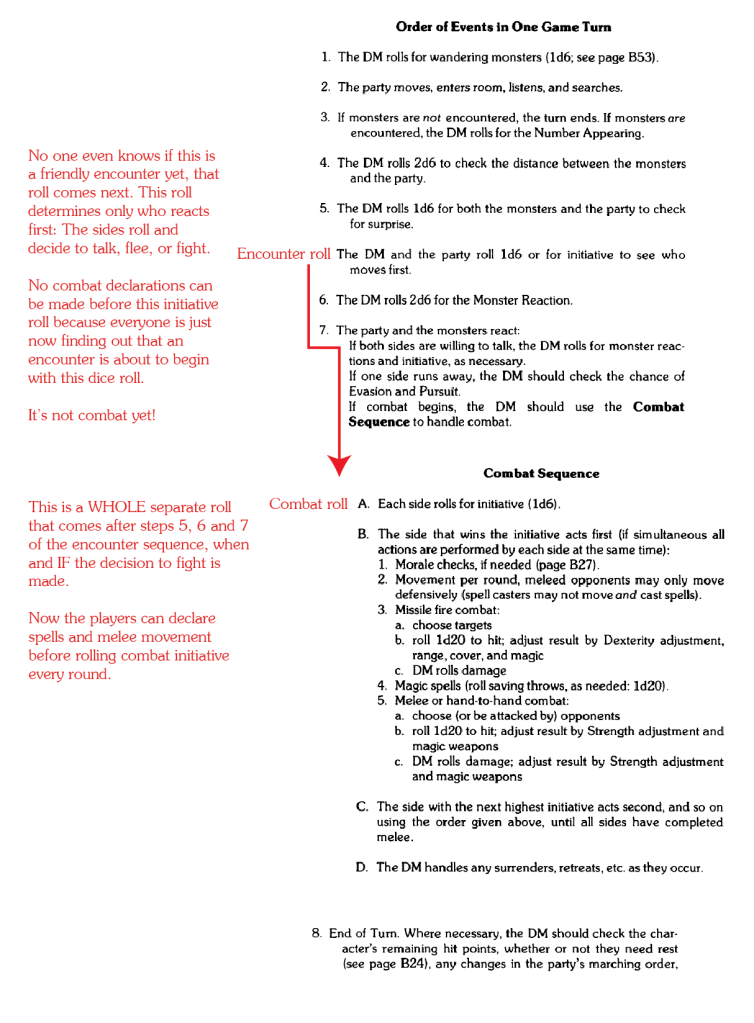
A lot of tables run right over the encounter initiative roll in OSE and BX games, but that mechanic is what allows PCs and monsters alike to avoid combat, run, hide, parley, surrender, and more.

Let’s review the sequence, starting with the encounter:

4. Roll for wandering, type, number, distance

5. Roll for surprise (none), Roll ENCOUNTER initiative

6. Roll monster reaction

7. Sides react, deciding to fight, talk, or flee.

If combat erupts:

A. Declare spells, movement, roll COMBAT initiative every round

    B. Winner acts (Move, Missile, Magic, Melee)

    C. Loser(s) act

    D. Surrenders, retreats, check morale at 1st and half

    So there are definitively two rolls.
    One happens right when the encounter has barely begun, and the other happens after steps 5, 6, and 7 are complete. A LOT of things can happen in that time, and only one of those things is combat:


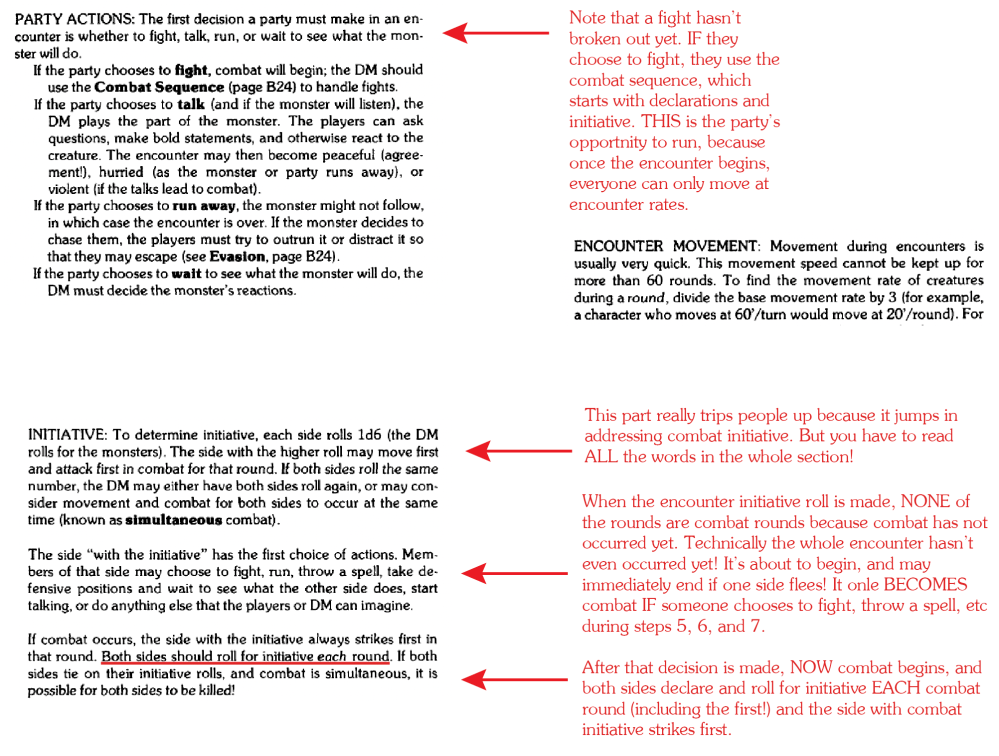
    So why is this confusing? Well, the explanation text that accompanies the sequences isn’t exactly in the right order, frankly.


    Example scenario 1:
    So, now let’s assume the party won the encounter initiative and decides to try to talk, hide, or take up defensive positions.

    Let’s also assume the monster reaction roll went badly: The monsters lost initiative, and will attack.

    If we apply the encounter initiative to the first round of combat, the party has given up their advantage! The PCs won the initiative, but now the monsters can walk up and punish the PCs for not attacking first.

    If we follow the sequence though, in step 7 everyone decides what to do:
    7.) The PCs stand their ground or talk, the Monsters decide to attack
    Combat Sequence begins:
    1. Declare spells and melee movement, roll combat initiative
    2. Initiative winner acts first

    That’s a LOT more fair. The PCs did their best to parley, the monsters attack regardless but the PCs might still get to strike first. And that’s a LOT more like real life; just because I decide to pick a fight doesn’t mean I get to throw the first punch!

    Example scenario 2:
    Let’s assume the PCs win the encounter initiative, and decide to attack.
    Firstly, they don’t even know what the monsters are or whether the monsters are violent! They just know an encounter is about to happen, and they won the initiative. Not even the DM knows whether they’re friendly or not, because that roll comes AFTER initiative.

    Secondly, they already know they won initiative without declaring spells or movement, so there’s no risk to them, but also there’s no way to apply adjustments for movement! The monsters haven’t even had the chance to exist yet, much less decide to retreat or cast spells, so the DM can also make advantageous meta decisions.

    Finally, the party might instantly vaporize the monsters only to discover it was a party of friendly NPCs looking to trade.

    Finishing all the steps of the Encounter sequence lets the sides see each other, and express their decisions to act. That tells everyone whether the encounter has been engaged, or avoided, and whether combat is about to begin.

    Example scenario 3:
    Try to imagine a neutral encounter goes south. The monsters win initiative, they’re cautious, but not violent. The players parley, a few minutes of RP dialog occur, and the monsters decide to attack.

    If you’ve decided “Well, the monsters won the initiative at the start of the encounter, so they get to attack you,” the table would erupt in argument. The players would demand a combat initiative roll. “That roll wasn’t for combat! It was just to determine whether we were going to talk or run or hide!”

    And they’d be precisely right.

    And that brings us to the final point:
    Encounters should be avoidable, and this is the mechanism for it:
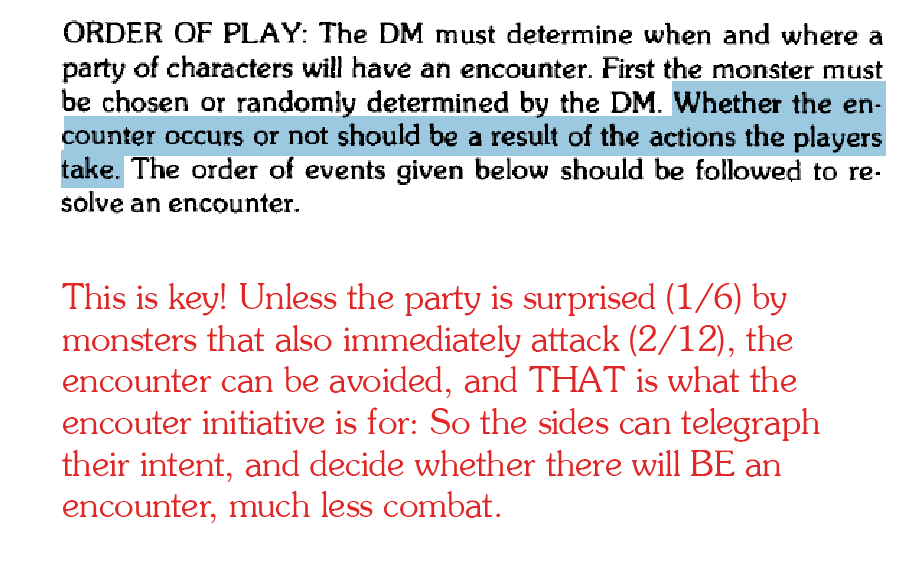
    Whether the players win or lose the encounter initiative roll, they get to decide:

    We want to stay and fight.
    We want to stay and talk – understanding it might result in a fight
    We want to hide – understanding we might be found and fight
    We want to flee and exit the encounter – understanding we may be caught and fight.

    But if you don’t separate the encounter initiative from the combat initiative, every encounter could instantly become combat, which automatically commits the party against their will.

    More thoughts in the comments, thanks to all who chimed in!

    5 responses to “Consider this: Encounter initiative rolls”

    1. Great observation. Have a question: If the party wants to flee, and loses the encounter initiative, won’t they automatically get caught since the monsters act first?

      Like

    2. I answered this and deleted my reply, because I can do it shorter, ha:

      Nope, they can still run away.

      Why?

      Because the loser of ANY initiative roll still gets a turn to do something. If the encounter initiative is Monsters:6, PCs:2, we don’t just blow past the PC’s turn to act as the encounter initiative losers — they get to act on their 2. The monsters use their 6 to decide to attack, the PCs use their 2 to decide to flee.

      “So the monsters won encounter initiative and want to engage combat, but they can’t?”

      Of course they can, they’re still attacking, but now it’s called pursuit! If the PCs stood their ground, the next thing you’d do is roll for combat initiative, because the monsters have decided “it’s on”. And if they catch up with the party, same deal. But at the encounter level, initiative winners AND losers still get to participate in what happens next.

      Like

    3. Taking a longer look, for what it’s worth, the PCs actually have a lot of opportunities to duck combat. If we look at the whole process:

      A roll of just 1 in 6 indicates wandering monsters. Just a 16% chance.

      A roll of 2d6x10′ is made for distance, so *most* monsters can only snag the party in melee if they’re within 60′. That’s about a 46% chance that they can close the gap in one round.

      A surprise roll is 2 in 6, and if the PCs win, they can just run.

      If no one is surprised, the PCs can win or lose and still flee – the monster reaction roll just determines the likelihood of pursuit.

      Finally, if the PCs are surprised AND the monsters roll a reaction of 2 (11 outcomes from 2 to 12 means a 1-in-11 chance so about 9%) then they are indeed committed to combat…

      … however…

      Remember, if the surprising/attacking monsters are distant, they still have to move at their combat rates! They could spend more than one round closing on the party, during which the party can try to escape by moving at their own combat rates. By the RAW, they can end the entire encounter a number of ways: They can drop food and treasure (50% chance to distract) drop flaming oil to slow them, AND while falling back, they can concentrate their missile attacks on one monster to trigger the first-death morale check. And if the party manages to break line of sight, most monsters should cease to pursue.

      That’s quite a few ways to end an encounter without combat.

      Like

    4. I really liked this. I’ll test it in my campaign. Brazilian greetings, Frank!

      Like

      1. Thanks for reading! I’m always looking carefully at the rules to figure out how to get the most flexibility out of them without homebrewing or porting in rules from other systems. In this case, it’s really all caused by ambiguous writing in the original texts.

        BX was vague by accident. OSE…. well… it’s more precise on many subjects, but I think Gavin deliberately stopped short of taking a side in a culture war. He explicitly clarifies that running is not possible once combat starts, but he stops there. He leaves it up to us to figure out WHY:

        – Combat is a type of encounter, so everyone moves at encounter rates.

        – Encounter rates apply once an encounter begins. Therefore you can not run during an encounter either.

        – It sounds like a catch 22: “If no one can run once an encounter starts, how are you ever allowed to run away from an encounter? Fleeing an encounter presupposes that an encounter exists to be fled!”

        – Therefore, there must be an exit mechanic (other than using the ultra-rarely won surprise round) to flee an encounter before it begins and run at 3x. Otherwise every encounter would be a commitment.

        Encounter initiative is that mechanic:
        DM rolls the encounter, encounter initiative is rolled.
        If winning side attacks and the losing side flees, pursuit begins at 3x.
        If winning side flees and losing side attacks, pursuit begins at 3x.
        If winning side attacks and losing side stands ground, roll combat init.
        If losing side attacks and winning side stands ground, roll combat init.
        If both sides attack, roll combat init.
        If neither side attacks nor flees, roleplay.
        If one side attacks mid-roleplay, roll combat init.

        Bottom line, surprise not withstanding:
        1. The party can always choose to play it safe and flee EVERY encounter whether they win or lose the encounter initiative. It’s always their choice to stay and engage the encounter, accepting that they will only move at encounter rates until the encounter ends – whether amicably or in combat.
        2. There is always a combat init roll so that there is a fair chance that even the side that was not planning to attack can still act first. That makes perfect sense: Attacking ANYONE who can see you coming means they could still hit you first, even if fighting was your idea!

        Liked by 1 person

    Leave a reply to Frankie Breakbone Cancel reply